
The History of Bibury
One of England’s most complete & unchanged
medieval wool villages
Bibury (pronounced as if spelt Bybury) is a medieval village beside the River Coln, in a sheltered valley where the river cuts through the rolling downland of Gloucestershire.
There is evidence of human settlement here going back over 2,500 years. On the hillside between Bibury and Ablington lie the remains of the Iron Age hill fort of Rawbarrow, covering around eight acres. Some 500 years later the Romans were here too, perhaps unsurprisingly given that nearby Cirencester was the second most important Roman town in England after London. In the late 1800s, the remains of a Roman villa and workshops were discovered beside the river near Bibury Mill and partially excavated in the 1980s.
The beginnings of Bibury as we know it today date to the late Saxon period, around 800 AD, when Wilfrith, Bishop of St Mary’s Priory in Worcester, granted land beside the River Coln to Earl Leppa and his daughter Beage. The name Bibury may derive either from Beagan-byrig (Beaga’s enclosure) or from the Old English bece or beke (stream) and berie (flat land). The location of the church, on level land within a loop of the river, supports this second explanation. The word beck is still used for a small river in parts of northern England.
The valley-floor setting offered shelter, fresh water from springs, and a ready supply of fish. The River Coln remains noted for its fishing, particularly Brown Trout.
Much of the village centre, around the church and river, consists of listed buildings. Bibury has been a Conservation Area since 1971, and the whole village lies within the Cotswolds National Landscape.

Arlington Row. Built in 1380 as a ten-bay wool store, it became redundant in the 17th century when the wool industry declined, and was turned into cottages.
Riding the wave of the medieval English wool boom

The Cotswold Sheep. In medieval times vast flocks of these large sheep grazed the downs around Bibury, and their wool was highly regarded in England and Europe. Yet nowadays they are regarded as a rare breed.
Bibury’s development closely mirrors the rise of the Cotswolds wool industry. Highly regarded wool from sheep grazing the surrounding downs provided the raw material for fine broadcloth used in cloaks, uniforms and weatherproof outerwear. Bibury exported both raw wool and finished cloth to markets across England and northern Europe.As European weavers once observed:
“The best wool in Europe comes from Britain … And the best wool in Britain comes from the Cotswolds.”
By the mid-1400s, wool and cloth accounted for around 80% of all English exports.Two factors particularly favoured England’s wool trade: the extinction of the wolf, allowing large flocks to be kept, and relative freedom from invasion. As historian W. I. Croome wrote in 1964:
“England … alone in Europe, could afford to run vast flocks of sheep and so enjoyed a monopoly of the rich wool trade.”
Wool was so important to the national economy that when it came under threat from imported fabrics in the late 1600s, Parliament introduced the ‘Burial in Wool’ Acts, requiring most people to be buried in woollen shrouds. Failure to comply attracted a £5 fine — possibly equivalent to around £800 today.
Bibury as a medieval wool factory
What appears today as a picturesque riverside scene was, for several centuries, a working industrial landscape.
Cotswold sheep grazed on the surrounding downs and were brought into the village for shearing. One likely route descended from Arlington Down into the village centre, arriving beside what is now Arlington Row. This well-known building was originally constructed in 1380 as a wool store, only becoming cottages in the 17th century as the wool trade declined.
The fleeces were spun into yarn and woven into cloth in the building now known as Weaver’s Cottage, attached to Arlington Mill. The mill itself functioned as both a corn mill and a fulling mill, where newly woven cloth was cleaned and thickened. The Domesday Book records that a mill existed here as early as 1086.
The finished cloth was stretched out to dry on wooden frames across Rack Isle, secured with tenterhooks to prevent shrinkage.
Remarkably, this medieval cloth-making landscape has survived with very little alteration. This continuity gives the heart of Bibury its distinctive character and exceptional heritage value.
Arlington Row and Rack Isle are owned by the National Trust. Arlington Mill and Weaver’s Cottage are privately owned.

Arlington Mill. There has been a watermill in Arlington since 1086 when it was recorded in the Domesday book. This one was built in the 1600s. It served as a cornmill and also as a ‘fulling mill’ for the locally-produced wool.

Bibury riverside: This stretch of the river was artificially straightened, possibly in the late 1700s when the stone road bridge in front of the Swan Inn was built. Until then it would have meandered between swampy banks. The southern end of the street became the village’s main shopping area.
The end of the wool boom
By the 1600s the industry increasingly concentrated around towns such as Stroud, where faster-flowing rivers could power larger mills. Competition from new fabrics and imported wool also played a part. As in many Cotswold villages, wool production in Bibury declined and the village returned largely to farming.
The mill reverted to corn milling, which continued until 1913. Thereafter, the building passed through various uses, while the riverside centre of the village remained largely unchanged — preserving a medieval industrial landscape into the modern age.

The main road bridge over the Coln. This stone bridge over the river Coln was built in the late 1700s. Before then there was only a ford. And a very cold one it was – thanks to the enormous volumes of fresh water that entered the river from the riverside springs upstream.

The Bibury Club
Between 1800 and 1825, Bibury enjoyed a brief period of national prominence through the Bibury Club, one of the earliest and most exclusive private horse-racing clubs in the country. Members included royalty, aristocrats and statesmen. HRH the Prince of Wales (later King George IV) was member number 2 and patron.
Michael Tanner described it as:
“one of those exclusive bastions of privilege, restricted by invitation to nobles and gentlemen.”
Accounts describe local shopkeepers renting out their bedrooms during race week and sleeping under their counters, while the parties at the Swan Inn became legendary. Racing took place on the downs near Aldsworth, and the old course still appears on Ordnance Survey maps.
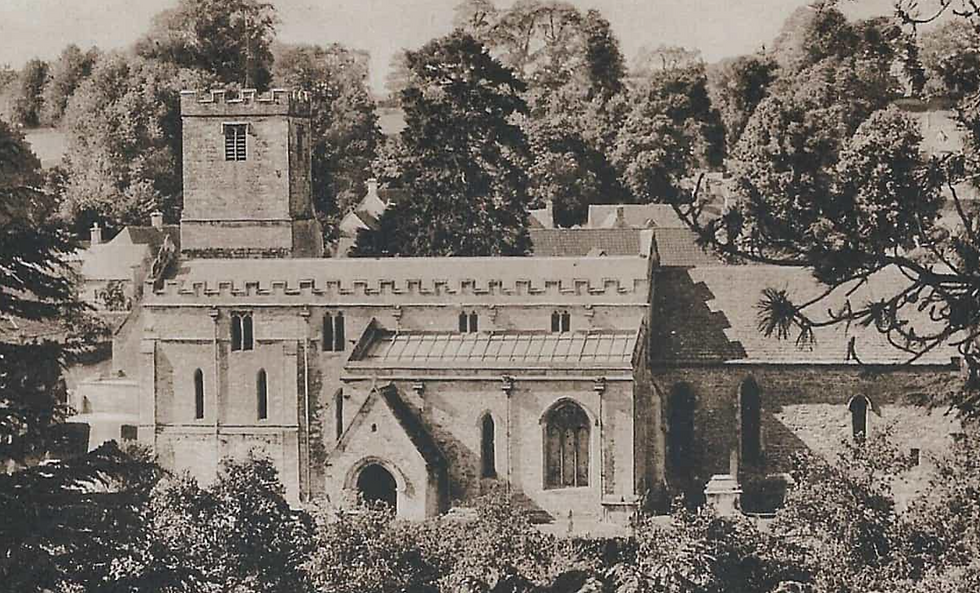
St Mary’s Church and monastic history
Bibury’s church and lands were held by Worcester Abbey and later Osney Abbey for around 750 years. The village church, St Mary’s, dates from around 800 AD and grew gradually over centuries as the population expanded.
It is a rare example of a church that evolved organically rather than being rebuilt in a single grand phase. Saxon, Norman, Gothic and Victorian elements can still be seen, and by around 1500 the building was largely as it appears today.
Varied spellings
In historical records the name Bibury appears in many forms, including Becheberie, Begaberia, Bebury, Bibyry and Byberry, reflecting the lack of standardised spelling in earlier centuries.
William Morris (1834–1896)
“Bibury is surely the most beautiful village in England, lying down in the winding valley beside the clear Coln.”
J. Arthur Gibbs, A Cotswold Village, 1918
“Bibury is indeed a pretty village …. Not a cottage is in sight that is not worthy of the painter's brush; not a gable or a chimney that would not be worthy of a place in the Royal Academy.”